
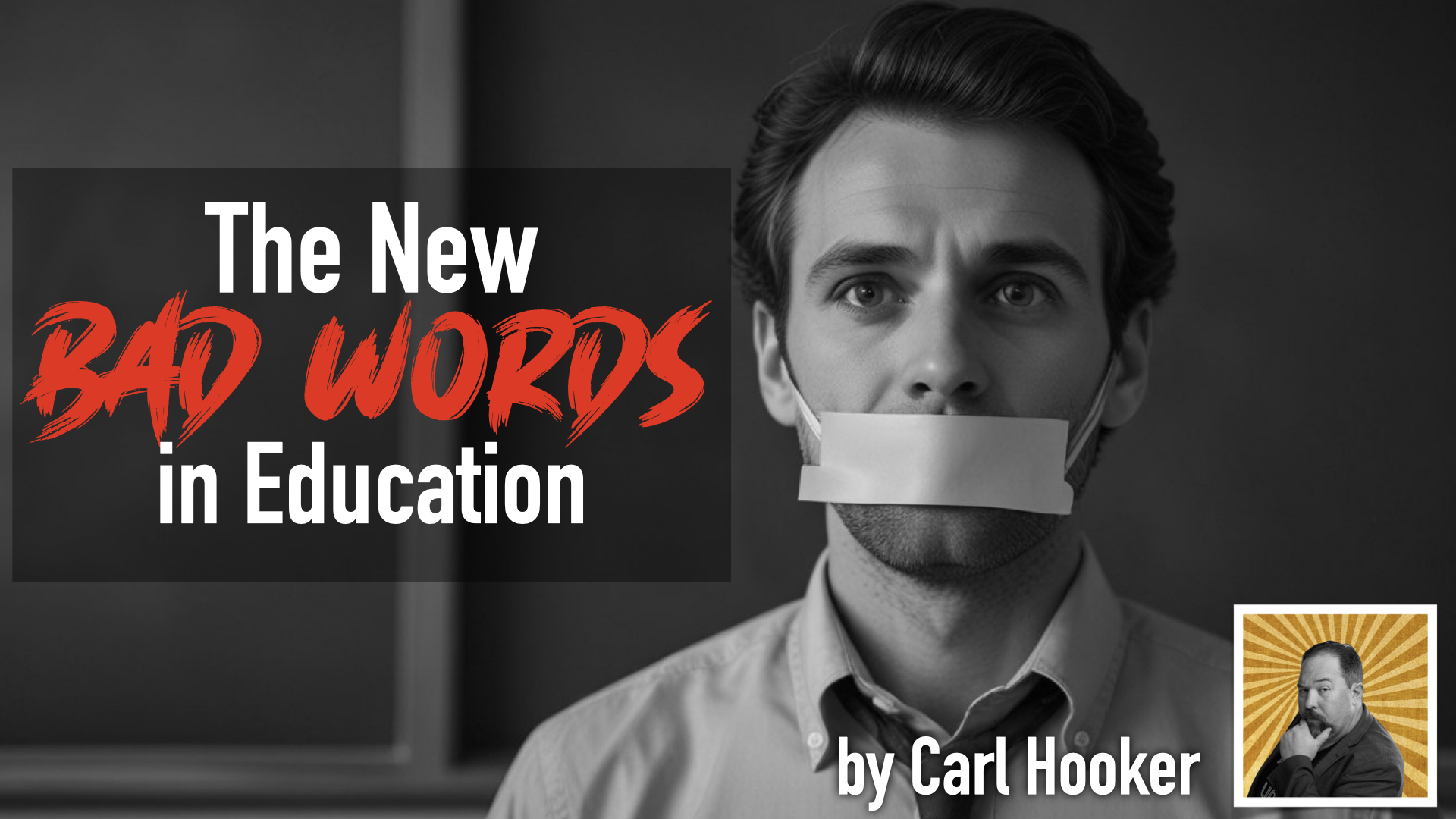
Warning: This post contains graphic language…just not the words you might think
When I started my teaching career I was always worried that I might let a bad word slip. My parents raised me in a house hold where they tolerated some colorful language as long as I didn’t use it outside the home. Of course, the second I got to middle school I realized all bets were off as my friends taught me all of George Carlin’s famous 7 words that you can’t say on television. (Google search it, I’m not linking this for you 🙂
Twice during my teaching career I got in trouble for swearing and both were by accident. Once, when I was teaching first grade I was calling students names for the car pick up line and reading the names of their parents’ car visors. I was tired, it was the end of the day, and that’s when I came across a student by the name of “Phuc” (pronounced Fook). Unfortunately, he wasn’t my student and I shouted out an obscenity at the top of my lungs without even thinking about it.
The other time was a few years later. I was teaching a group of 5th graders in the computer lab and they were all standing up doing some sort of activity. It was starting to get louder than normal and I noticed a teacher walk by with a discerning look. I then turned the class and immediately told them to be quiet and sit down. Only, I didn’t say “be quiet”, I said “SHHHHH” and I didn’t tell them to sit down, I told them to “SIT”. However, I spoke with such speed that the SHHHH mashed with the SIT and became one very vulgar word. Laughter ensued as my face turned 17 shades of red.
The new bad words
While saying those words in front of students isn’t a good thing, they won’t necessarily get you fired or suspended. You might get a slap on the wrist, a chuckle from an administrator, or at worse a dreaded “write up” in your file. (To this day I question whether that file exists, but I digress.)
Over the past several years I’ve seen a growing discernment of what teachers are teaching kids. In the past parents were concerned about whether their child could read, now they are concerned with what they are reading. It’s fine to learn your ABC’s, but you better not learn your CRT’s. (Hmmm…I just thought of a new song by the Jackson 5…)
Communities of parents are worried that AI will replace critical thinking while other communities of parents are worried about the fact that we use the word “CRITICAL” in anything. Bias is something that exists in all humans and innately all artificial intelligence systems, but mentioning “biases” to students could get you in hot water. After all, freedom of speech doesn’t mean freedom of consequences.
Acronyms gone wild
That brings me to the list of acronyms that shall not be named. Feel free to say LMFAO and WTF all day long, but stay away from loathsomely evil terms like DEI and SEL. As of this past week, 30 states have anti-DEI legislation targeted at public colleges. Last week I posted on my LinkedIn account asking the question “When did DEI become an evil villain?” It seems to be the thing to blame for everything wrong in society. Our own president even alluded to DEI being one of the causes of the recent DC plane crash.
I’m a white male. I know I have many inherent privileges afforded to me because of my race and gender and I’ve experienced it first hand. I’ve also experienced how powerful it can be to have a diverse group of people working together. Diverse in thought, race, background, belief, age and gender. In my previous role as a school administrator, without any official “DEI” initiative in place, I tried to bring together a diverse team of educational technologists. I didn’t do this for a pat on the back or to check a box. I did this because research shows that diversities within organizations lead to more creativity.
As someone who hosted a conference for nearly a decade (iPadpalooza, LearnFest), my team put a lot of thought and effort into choosing a diverse line-up of speakers on a variety of topics. When you have an opportunity to put someone on stage and highlight their work, you should take advantage of it. I vividly remember the amazing Rafranz Davis getting up on the stage and sharing that sometimes people can’t be what they can’t see. That made a tremendous impact on me and my work going forward. In my case, I felt like with great privilege comes greater responsibility.
The new list of words you can’t say
This week, the NSF and CDC began pulling websites and scraping through historical documents to redact and pull any mention of the over 100 words they’ve been told to purge via President Trump’s executive order. Of course, just like with George Carlin’s 7 words, I immediately began to wonder what words made the list.
You can probably guess some of these: marginalized, racism, diversity, inclusion, equity, bipoc, LGBT, and culturally responsive are just a few that I sadly wasn’t very surprised to see on the list. However, there were more than a few words that I did find surprising made the list. Words like trauma, women, victim, hate speech, female, and advocacy. Words that strangely didn’t make the list were male, white, majority, exclusion, or historical overrepresented. Now I should explain at this point that the above words were meant as content triggers. Documents where these words appear need to be looked at and possibly edited or redacted. Those combing through the websites and documents will likely spend months altering history to appease this new Executive Order.
I’d be willing to wager money that mistakes will be made as folks try to comply and stay out of trouble. In fact, I don’t even have to make this bet because it’s already happened. This past Monday, an exhibit at the NSA museum honoring women and people of color was covered up with brown paper as they tried to make heads or tails of this new order. (see pic below)

Now here’s where it gets REAL interesting. I decided to pull up the U.S. Constitution and just out of curiosity, see if any of the new “trigger words” make the list. It turns out there are 4 words in our Constitution that might either need to be redacted or re-written: Equity, minority, prejudice, and privileges. Think about that for a minute. What would our Constitution look like without those words in it?
What does all this mean for educators?
As we move toward a more state-focused system for education, I see potentially a geographic shift where teachers and families move to states that more closely align with their beliefs. Sadly, this will mean an even greater divide within our country as we no longer see enemies outside our borders, but instead inside them. As of now, these trigger words are relegated to federal agencies so, depending on the state you live you, teachers should be fine having conversations with students that use these words.
However, if you live in certain states and want to keep your job, you’ll have to be careful about what you say and what you teach. Social Emotional Learning (SEL) is a research-backed strategy that helps with students’ mental health and well-being. But as of 2023, 8 states have introduced legislation that would ban the use of the phrase “SEL” and any teaching centered around it.
As an educator, I always found a way to reach the students and connect with them. Those strategies included being social and taking into account their emotions. I got involved and interested in their diverse backgrounds to help make a connection with them and find a source of motivation to empower their own learning. When conflicts arose in the classroom, rather than excluding others, I preached the power of “building a bigger table”. The connections we make in life are so much more important than the words in a textbook.
Are there alternate words we could use?
I’m a heavy user of AI, especially in situations where I get stuck, so why not employ ChatGPT to come up with some ideas. I was surprised by the output when I asked it to list alternative phrases to DEI. Most of the outputs wouldn’t work, because of the words used to make the new acronyms but one in particular stood out as a potential:
Justice, Equity, Diversity, and Inclusion (JEDI)
How could anyone, except someone from the Empire, be opposed to teaching kids to be more like a JEDI?
Let’s be clear. This isn’t about words. This is about power. As a teacher, we need to continue to educate ourselves and our students what history has taught us when kings, dictators or even elected politicians try and erase past events.
Dr. Martin Luther King, Jr. is recognized and honored every 3rd Monday in January. His “I Have a Dream” speech is arguably one of the greatest speeches ever recorded. In the speech he uses words like black, victim, equality and racists. You guessed it, these are all words on the new trigger list. However, I do want to call out one particular part of his famous speech. King states that he has a dream that one day his children would live in a nation where they would not be judged by the color of their skin, but by the content of their character.
I have a feeling we will be judging a lot of characters in the days and weeks to come. May the force be with you.
JEDI – Love it!