
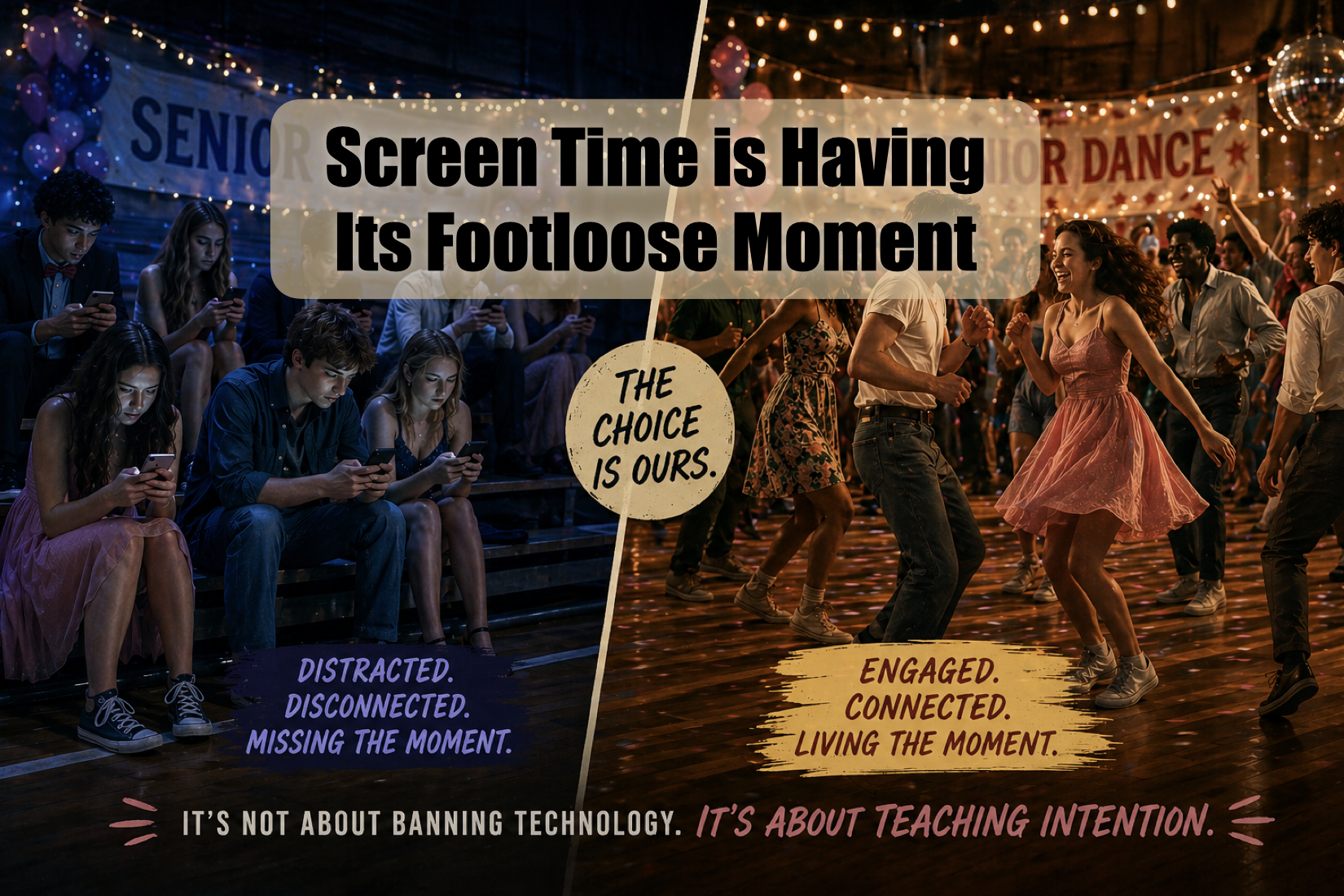
I was on a recent podcast with a couple of fellow educators discussing the latest Los Angeles Unifed School District move to ban all screens from K-1 students and severely limit it for 2nd through 5th graders. As we unpacked how we got here, I couldn’t shake one thought:
We’ve seen this movie before.
Literally.
Here’s a hint – It’s a1984 Kevin Bacon classic with the groovy Kenny Loggins soundtrack.
For those of you who haven’t seen the original movie Footloose (SPOILER ALERT), it centers around some teens in a conservative farm community where dancing is banned. That’s right, due to several reasons I’ll get into in a second, no one is allowed to DANCE. While this seems silly to fathom for most of us, every generation has had its “this is ruining our youth” crisis. Back then, in that small community, it was dancing. Now, in our globally connected world, it’s doomscrolling. But I think we can learn a lot about our current landscape through the beats and plot points of this 40+ year-old movie. God, I feel old saying that.
Moral Panic vs. Measured Concern
In the movie, the main impetus for the ban was an overcorrection driven by fear and grief. A town tragedy (the loss of the Reverend’s son and several other teens) caused the town to overreact in many ways. As those teens were dancing and drinking before their deaths, the Reverend used this as motivation to help the town forgo these “immoral behaviors.” Dancing (or the screen today) was the main focus of the ban even though other things like drinking (or social media content) played a major role in the tragedy.
In 2020, we all faced our own tragedy of sorts. With COVID-19, the world stopped and we were all forced to move to online learning. Schools were given relief funds to purchase new devices and tools to help with learning remotely. Eventually, as the kids came back into the schoolhouse, we continued to teach in a dichotomous way. There would be the traditional lecture-based teaching but now we had digital worksheets for students to use.
We didn’t just adopt technology….we flooded the system with it. Devices showed up faster than training, faster than pedagogy, and faster than purpose. Instead of an opportunity to truly integrate (or blend) learning between analog and digital, we gave way to poor digital behavior and an overindulgence in gamified experiences when students were on their devices.
Add that lack of thoughtful integration with recent concerns about the addictive nature of some apps (see recent Supreme Court ruling) alongside poor pedagogical practice of certain edtech tools, and you can see why this might be a recipe for disaster.
Make no mistake, this backlash was coming before the pandemic. The “Screen Time Warriors” as I call them were already out in full force. And while some of their tactics and reasoning were off balance, in some ways, they weren’t wrong. We allowed the kids to drink and dance without modeling appropriate use. We didn’t have any restrictions or balance between their online lives and actual lives.
A ripe recipe for moral panic, but this isn’t really a story about screens. It’s about what happens when we try to solve complex behavior with simple bans.
Banning the Symptoms vs. Addressing the Cause
The true story of Footloose was based on a real-life ban of dancing in the town of Elmore City, Oklahoma. This ban dated back to 1898 to “prevent carousing, heavy drinking and sexual arousal among youths.” It kind of reminds me of the dangers of a pool hall as espoused in the musical Music Man (“Oh we got trouble! Right here in River City!”). But I digress. In 1980, the town teens rallied to lift the ban which meant no high school proms up until that point. The kids literally fought for their right to dance.
In the movie, the real issue of the ban is a combination of unresolved trauma and a lack of communication. Dancing was seen as one of the symptoms of immoral behavior which led to the unfortunate death of these teens, but the truth was there were deeper issues at play here. Parental guidance (or lack thereof), community values, social pressures, and school events were all caught in the crosshairs of the ban. The adults were making decisions for the kids without listening to them.
There’s a similar tension at play today. Students often feel policies like statewide or schoolwide phone bans are done to them, not with them. Schools and state laws are created to restrict devices and screen time, but screens aren’t really the issue. Much like the movie, dancing wasn’t the danger. It was what surrounded it. Screens aren’t the danger either. It’s what’s built into them. A ban on devices means no teaching or training of digital literacy skills.
Just like the movie, the kids didn’t know how to dance until outsider teen named Ren (played by then 24-year-old Bacon) started showing them the moves. In and out of our homes, this plays out today with kids sharing inappropriate content or showing bad digital citizenship online (as well as some adults). Given the lack of resources due to these bans, kids are literally left to their own devices. Every generation thinks it’s saving kids from something. The question is, are we saving them or silencing them?
Unintended Consequences of Device Bans
Here’s the real unintended consequence no one is talking about: If schools don’t teach digtial balance…someone else has to. Let’s say this school screen time ban that LAUSD is attempting is successful. That means no devices or screen time until essentially 8 years old. Then after that, extremely limited screen time until 11 years old. On the surface, that sounds great when you consider student mental health and the addictive nature of some apps. Students today struggle with attention, anxiety, and sleep. Rather than blame current society and parental guidance, eliminating screens becomes a magical panacea for all our cultural ills.
But there’s a problem.
If educators are not showing any type of guidance or very limited guidance on the use of the technology in a positive way, that means it falls on the parents to do so. They can also elect to eliminate screens and follow the same guidelines as the district, or not. They could also follow the American Academy of Pediatrics’ (AAP) recent screen time guideline update too. Those guidelines mention the following:
- Less than 18 months old: No screens except for FaceTime calls.
- 18-24 months: Co-view highly educational programming with child.
- 2-5 years old: Limit to 1 hour a day of educational use or highly social programming.
- 6+ years old: Have healthy limits in place being mindful of social interaction, amount of sleep and exercise.
Notice that the AAP suggests creating healthy limits with students in the K-1 range of age. However, those ages are not allowed to learn that in the LAUSD scenario. Students between ages 8-11 will have limited opportunities as well to learn that balance, which means when they enter middle school, the training wheels will come off. We’ll be relying on those middle school teachers to help pre-teens how to manage their digital lives while also battling hormones on top of learning how to deal with middle school. This could be a problem.
Of course, if parents help with this at home, it won’t be. And there’s the catch. In order to make a ban like LA is proposing work, they need parent support, buy-in, and training. If they are truly doing this for the betterment of students’ attention and mental state, that should be an accompanying component of any type of technology ban. The parents now have an extra responsibility of teaching their kids how to dance.
The ZENgaged Approach
In my book ZENgaged, I tackle the many concerns districts like LAUSD and the group behind the ban called Schools Beyond Screens. The main premise is that we need to teach balance over bans. You can take away the phone but are you addressing the habit? Having healthy conversations should be a part of any type of community-wide restriction policy.
Here’s my approach to get kids in a more ZEN-like state with their devices:
- Z (Zero in): Notice when tech is helping vs. hijacking. Have conversations with students before and after they spend time on the screen.
- E (Engage): Use devices with purpose, not default. Use the technology to help build deeper learning and connections, not just for something fun to do on a screen.
- N (Navigate): Build awareness of digital habits in real time. Rather than ban it, have students consider reducing time spent on screens and discuss what value and joy their devices bring.
Because the goal isn’t to remove technology from students’ lives. It’s to help them own how they use it. Banning it without support doesn’t help with any of this. It’s like the scene below in the movie when Ren is teaching Willard how to dance. It’s messy and frustrating for him. Imagine if they had some adults that could help model and teach ways to manage their feet?
Instead of Banning the Dance, We Should Teach the Rhythm
By the end of Footloose, the town doesn’t double down on the ban. They work with the teens to figure out a way to find a balance. Using an old warehouse, they create a safe space for the kids to host their dance. Essentially they created structure with space for kids to learn, connect and explore together in a safe way. Boundaries with trust.
That’s the opportunity in front of us right now. We shouldn’t be talking about either a total lockdown or total freedom, but something far more challenging and powerful. We should be teaching students how to live, learn, and thrive in a world where the music never stops.
You saw what happened when they tried to ban dancing. It didn’t work.
Let’s make sure we’re not banning thinking this time.
Don’t ban the dance.
Teach the rhythm.
0 comments on “Screen Time is Having Its Footloose Moment”