

For the past three years I’ve been traveling all over the country to talk to educators, students, and leaders about the implementation of AI in schools. The responses have ranged from enthusiastic to completely opposed. One school I presented at had community members outside actively protesting the implementation of data centers in their community and, in turn, the use of AI. I’ve seen a teachers’ union question administrators’ use of AI when writing evaluations. All this to say, the implementation of these tools has been bumpy at best.
Over the course of my keynotes, consulting and professional learning, I always ask the audience or group for feedback on some various aspects of AI. It’s been interesting to watch the evolution of AI fears go from cheating to loss of critical thinking to environmental impact. The findings I share below are an aggregation of over 10,000 interactions with educators and students around the use of AI.
Finding #1: There is a rise in student push-back against AI
If you watched any of the commencement or graduation addresses from last spring, you’ll notice there’s a trend: Not all students are on-board with using AI. Even in my own household, I find that not all teenagers are as eager to outsource their learning to AI as we originally thought. Sure, there are still a lot that are using it to cheat or cut corners, but in my talks with high school and middle school students, more and more are asking me “do I have to use AI?”
This reminded me of some talks I was having with teenage students back in the 2010s around social media. There was a big push for students to use it correctly, but not all students necessarily wanted to be a part of that movement. They saw their friends becoming addicted to Instagram or TikTok and didn’t want it to dominate their own lives. In many ways, those students 10 years ago were aware of something that many adults didn’t want to believe or regulate. In fact, Meta (Facebook and Instagram’s parent company) just settled a multi-billion dollar lawsuit for making their apps more addictive to keep kids on their platform.
If you are an organization or school that is developing guidelines around the proper use of AI in schools, you need to make sure you have some student representation in the process. Their insight is valuable and having different perspectives make the resulting guidelines even stronger.
Finding #2: Loss of critical thinking is the top concern for educators
While cheating dominated most of my survey results in 2023 and 2024, lately, educators are increasingly concerned about the lack of critical thinking and foundational thinking skills. This survey below was from a group of over 200 educators and you can see that the top results all have some commonalities.

If I’m being honest, this is my top concern as well, not only for kids, but also for adults. I see it in my everyday life already. When I’m faced with a challenge, I reach for ChatGPT to help me troubleshoot it. I think that type of usage of AI is fine, but I worry that it will creep into all of our thinking one day. It already has tremendous influence on our daily lives and if you’ve been invited to a party or event in the last few months you’ve probably also experienced what I call the “AI Slopamaggedon” of graphics.
In the pursuit to make our lives easier, there’s a trade-off happening. We are giving up some productive struggle under the guise of automation. I wrote about the “Double-Edged Sword of AI Efficiency” some months ago as a way to make us all aware that using AI to do things faster doesn’t necessarily mean ‘better’. Sure, I could have fed some prompts into Claude and had it write this entire blog for me, but I’d be missing out on the deeper thinking that happens when researching and writing. I’ve seen presenters use it to design their slides for their presentations, which is their prerogative (now I just got a Bobby Brown song stuck in my head…).
For me, part of the joy I get when speaking and presenting is the time and effort it takes to design slides that align with my main messages. Don’t get me wrong, if AI stops the “Bulleted PowerPoint” slide, I’m all for it. But I think this same feeling of struggle and problem-solving needs to happen with kids. They may not be a fan of the topic or subject, but learning happens in those times of discomfort and struggle. As educators, we need to make sure we are balancing that learning struggle with the students’ use of AI.

This graphic above (partially created by AI and partially by me) is one that I show teachers and leaders when it comes to the concerns around the loss of critical thinking. Students can stand on the left side of the moving walkway and let AI do all the thinking for them. Perhaps they’ll still learn a little, but it won’t be deeper learning. Almost like when we used to cram for tests back in the day. You could regurgitate information for an exam, but a few hours later that content was gone from your tired brain.
There are times we need students to not use AI or technology to help them learn (represented by the person on the right, outside of the moving walkway). Students work with other humans and independently to ask questions, brainstorm, and attempt to solve problems. Then, there are times when we, as educators, don’t have time to dive deeper into a topic. That’s when the combination of human thinking and AI come in handy like the person walking on the moving walkway. While we might have to move on to a different topic or standard, AI can help that student who wants to dive deeper into something that interests them. It’s not helping them learn faster, it’s helping them learn deeper.
Finding #3: There are some human traits that AI should NEVER replace
Every year for the past three years, the Harvard Business Review has listed the top 100 uses of AI globally. Many of the concerns listed in Finding #2 become apparent when you see how everyone is using AI. For the past two years “Therapy and Companionship” has been the top use of AI. Whenever I reveal this to an audience, I can hear a combination of audible gasps and the sound of people breathing in through their gnashed teeth. This concern prompts me to ask the audience a question: What are some human traits, skills and activities that AI should NEVER replace? Below is just one example from an audience of 80 teachers.

Selfishly, I like that a couple of folks said “keynotes” should not be replaced, but I know it’s only a matter of time before I go to a conference and someone has an AI-generated keynote speaker. All joking aside (maybe?), looking at the above survey results reveals some things that I think are important in a classroom setting and beyond. Those traits that make us most human (empathy, love, compassion, friendship) should never be outsourced to a machine.
If you are an elementary teacher reading this blog, you might be thinking, this doesn’t really affect me as my students can’t really use AI yet. While they may not be using it yet, one thing elementary teachers MUST do is lay a foundation of AI literacy with their students. Young kids don’t often know that a tool like AI or the “Alexa” at your house isn’t really a person. They tend to anthropomorphize it and call it “him” or “her” when in fact, it’s really an “it”. By describing what it is, how it works, and modeling its appropriate usage at the elementary level, our students will have a stronger understanding of when and why it should be used later in their educational journey.
For older students, it can be a powerful, unemotional tool for feedback on an assignment or idea. A student who is worried about what a peer or teacher might think about their work, doesn’t have to worry about emotionally maneuvering a criticism given by AI. It’s tempting just to have AI act as a feedback engine, but just like some of the results in the survey above, that would strip away some very HUMAN skills. Students need to understand both how to give and receive critical feedback on their work from other humans. Secondary teachers can utilize AI to help with some of this, but they should never eliminate the human from the loop.
Finding #4 – Worry about the job market is real
School doesn’t exist for kids to get a job when they graduate. That said, our main goal should be to create productive and fulfilled members of society. Part of that contentment (at least in the U.S.), comes from having a career and earning an income. The growth of AI and its impact on the job market is real. Anthropic, the company behind Claude, published the following graphic to show the areas which AI is already impacting in the job market.
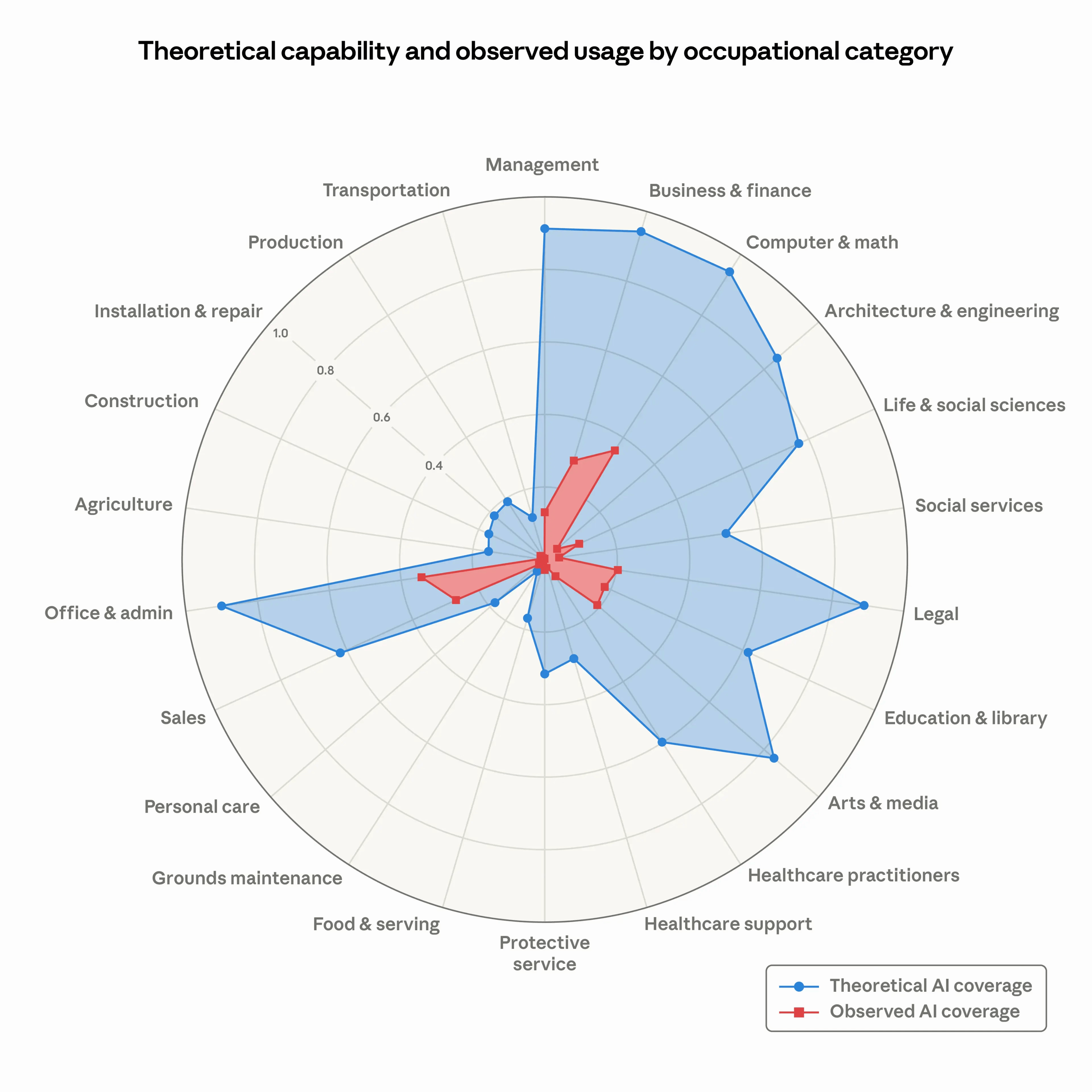
Students and teachers alike share concerns about what areas AI is affecting. The impact of AI on the job market is real and should be discussed with students before they leave our institutions. As you can see from the graph above, certain areas (computer, math, law) are going to be extremely impacted while others (service, healthcare support, construction) won’t be as much. As a matter of fact, the U.S. is facing a national shortage of 81,000 certified electricians between now and 2034. Those CTE fields will become more and more important as AI infiltrates all areas of work going forward.
Education isn’t exactly in the clear either. You’ll notice in the graph that the theoretical coverage of AI in “education & library” is growing. Does that mean that we’ll replace teachers with robots? Likely not. However, it has already been attempted multiple times with the most recent fiasco coming last month when a school in New York tried to insert “Sally” the robot into a classroom. While this robot acted like a humanoid Echo device, the real pushback came when the community discovered what factory the robot came from (it came from a sex robot factory).
While all the attempts to make this happen in education have failed, you can bet it will continue to be brought up as schools face teacher shortages and funding shortfalls. The truth is, a teacher who uses AI thoughtfully can be a powerful educator. They can use it to truly differentiate for their students and give students a chance to dive deeper into topics they want to learn about. For students that struggle with text-based learning, a teacher can use AI to create graphics, explainer videos, or even a podcast recap of a learning standard.
Closing thoughts
We have reached the “Trough of Disillusionment” in the Gartner Hype Cycle when it comes to AI. The added environmental impact of data centers has further deepened the trough both in and out of schools. To work our way toward the “Slope of Enlightenment”, educators need to see not only the impact of AI in the future of their students, but also help them understand how to use it properly.

We can no longer put our heads in the sand. AI is the genie who is not going back in the bottle. That doesn’t mean we have to use it for everything though. Going forward, designing experiences where human creativity and ingenuity can shine will be paramount in the classroom. Literacy around the usage of AI and understanding how it works will be an essential part of learning for every K-12 student. As with everything in life, finding a balance between machine and human will be one of the most important skills for students to master in the future.
That should be our primary prerogative going forward. And in the words of the late Bobby Brown, when it comes to AI: I don’t need permission, make my own decisions…that’s my prerogative.

Carl Hooker is a 28-year educator that speaks with communities and schools around the thoughtful integration of technology including AI, screen time, and digital wellness. Check out his latest books ZENgaged and Learning Evolution:2nd Edition. For more information on how to book Carl for you next convocation, staff training or community event, fill out this form.
Pingback: Maybe the Problem Isn't Too Much Technology - Hooked On Innovation